
Why Ohio Fleet Management Insurance Is Critical for Your Business
Ohio fleet management insurance is a specialized type of commercial auto coverage that protects businesses operating multiple vehicles — combining liability, physical damage, cargo, and more under a single policy.
Here’s what Ohio fleet operators need to know at a glance:
| Topic | Key Facts |
|---|---|
| Minimum vehicles for fleet policy | Typically 5 or more |
| Ohio state minimum liability | $25,000 per person / $50,000 per accident / $25,000 property damage |
| Commercial vehicle minimum | $750,000 combined bodily injury and property damage |
| Core coverages | Liability, cargo, physical damage, uninsured motorist, PIP |
| Multi-state coverage | Available — critical for interstate trucking operations |
| Cost factors | Vehicle type, driver history, cargo value, coverage limits |
Ohio has nearly 989,000 small businesses, and a large share of them rely on commercial vehicles every day. With 11.7 million residents crowding Ohio’s roads, the risk of accidents — and the financial damage that follows — is very real.
Personal auto insurance simply won’t cut it for business use. If an employee causes an accident in a company vehicle, a personal policy will likely deny the claim entirely. Fleet insurance fills that gap, protecting your drivers, your vehicles, and your business assets under one streamlined policy.
For small trucking businesses especially, the stakes are even higher. You’re managing multiple vehicles across state lines, hauling valuable cargo, and navigating a complex web of state and federal regulations — all while trying to keep costs under control.
This guide breaks down everything you need to know to get it right.

Navigating Ohio Fleet Management Insurance Requirements
Operating a fleet in the Buckeye State isn’t just about getting from point A to point B; it’s about doing so within the bounds of the law. Ohio has specific financial responsibility laws that every business owner must respect. If you’re caught without the proper coverage, you aren’t just looking at a ticket—you’re looking at personal liability for accidents and potential state legal action that could shutter your business.
The baseline for any vehicle on an Ohio road starts with “split limits.” For a standard fleet vehicle, the state requires a minimum of $25,000 for bodily injury per person, $50,000 for bodily injury per accident, and $25,000 for property damage. However, if your vehicles fall under the “commercial” umbrella—meaning they are used for hauling goods or passengers for hire—the bar is set much higher.
State Minimums vs. Commercial Reality
For most businesses, the state minimum is rarely enough. Ohio commercial vehicles are generally required to carry at least $750,000 in combined single-limit coverage for bodily injury and property damage. This higher threshold is designed to protect both the public and the business in the event of a catastrophic collision involving heavy equipment or high-velocity transport.
To stay compliant, we recommend reviewing the Ohio Guide to Auto Insurance provided by the Ohio Department of Insurance. Additionally, if your fleet operates across state lines or involves heavy trucking, you must adhere to federal Motor Carrier Insurance Requirements to maintain your operating authority.
| Vehicle Type | Bodily Injury (Per Person) | Bodily Injury (Per Accident) | Property Damage | Combined Single Limit |
|---|---|---|---|---|
| Standard Fleet Vehicle | $25,000 | $50,000 | $25,000 | N/A |
| Commercial/Heavy Truck | N/A | N/A | N/A | $750,000+ |
| State-Owned Agency Vehicle | N/A | N/A | N/A | $2,000,000 |
Customizing Ohio Fleet Management Insurance for Diverse Vehicle Types
A common question we hear is: “What actually counts as a fleet?” In Ohio, businesses with five or more vehicles typically qualify for a fleet policy. The beauty of Ohio fleet management insurance is that it doesn’t care if your vehicles are all identical. You can have a mix of semi-trucks, delivery vans, passenger cars, and even specialized equipment all under one roof.
Managing this variety is made easier through VIN decoding and advanced policy management. This allows us to track the specific risks associated with each unit—from a heavy-duty dump truck in Columbus to a small courier van in Cincinnati. Furthermore, if your business grows beyond Ohio’s borders, your fleet policy can be tailored for multi-state coverage, ensuring you meet the unique filing requirements of every state you enter. Whether you are adding a new trailer or hiring a new driver, you can find more info about trucking services to see how we help streamline these transitions.
Essential Coverage for Cargo and Liability
While liability is the legal “must-have,” it’s only one piece of the puzzle. To truly protect your bottom line, you need a comprehensive suite of coverages:
- Bodily Injury & Property Damage: This covers the costs if your driver is at fault in an accident that harms others or their property.
- Cargo Insurance: If you are hauling goods for others, you need specific protection for that freight. Whether it’s electronics or industrial machinery, check out our Cargo Insurance Guide to understand how to protect your load from theft, fire, or collision.
- Physical Damage: This includes collision (damage from hitting something) and comprehensive (damage from fire, theft, or weather).
- Uninsured/Underinsured Motorist: Given that not every driver on Ohio roads follows the rules, this protects you if one of those drivers hits your vehicle.
- Special Hauling Permits: If your fleet handles oversized or overweight loads, Ohio requires a specific Endorsement of Liability Insurance Policy (Form OS-32) to obtain the necessary permits.
Risk Management and Telematics for Ohio Fleets
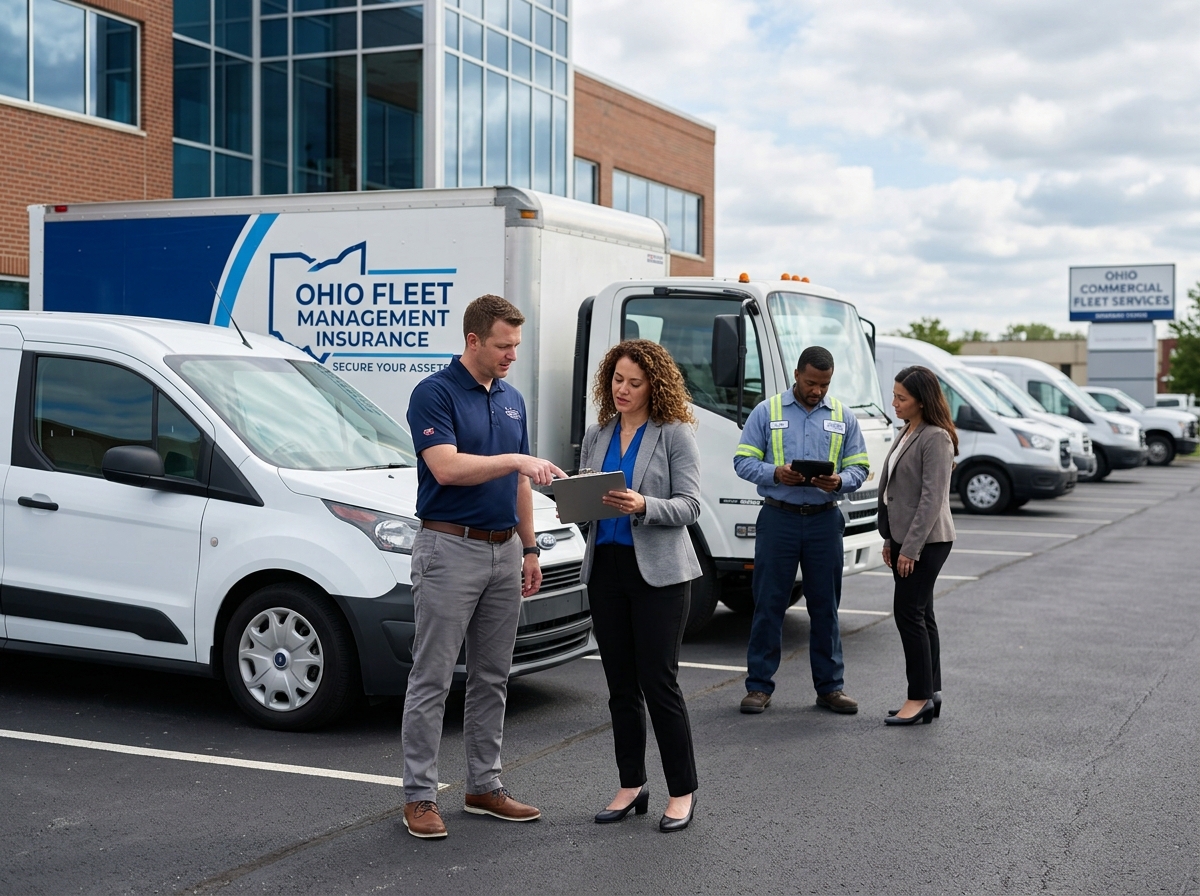
“Set it and forget it” insurance is a thing of the past. To keep premiums low and drivers safe, Ohio businesses are increasingly turning to telematics. Telematics isn’t just about knowing where your trucks are; it’s about understanding how they are being driven.
By using GPS tracking and vehicle diagnostics, fleet managers can access a full suite of fleet-tracking services that provide real-time alerts. Imagine being able to see that a driver is consistently hard braking or speeding on I-71 before an accident actually happens.
Data shows that fleets using these tools see significant improvements:
- 43% reduction in vehicle breakdowns.
- 44% reduction in hard braking incidents.
- 37% reduction in speeding.
- 19% reduction in idling time, which saves a fortune on fuel.
Maximizing Savings with Ohio Fleet Management Insurance Safety Initiatives
Insurance companies love data, but they love safety even more. When you implement a formal safety culture, you aren’t just being a “good boss”—you’re actively lowering your Ohio fleet management insurance costs.
A solid safety program should include:
- MVR Monitoring: Regularly checking Motor Vehicle Reports for all drivers to ensure no major violations have occurred.
- Driver Training: Periodic coaching on defensive driving and cargo securement.
- Gamification: Some telematics platforms allow you to “score” drivers, creating friendly competition for the safest record, often rewarded with bonuses or recognition.
These initiatives often lead to premium discounts because they demonstrate to underwriters that your business is a “low risk.” If an incident does occur despite your best efforts, having an organized system makes it much easier to Report a Claim and get back on the road quickly.
Compliance and Accident Protocols for Ohio Operators
When an accident happens, the clock starts ticking. In Ohio, the State of Ohio BMV and the Department of Transportation (ODOT) have strict protocols. For example, if you are involved in special hauling, ODOT will not accept a standard Certificate of Insurance (COI) for permits. Instead, they require the specialized Form OS-32, which must be signed by an authorized insurance representative.
If one of your drivers is involved in a collision, here is the immediate checklist:
- Safety First: Ensure everyone is okay and call emergency services.
- Document Everything: Take photos of the scene, the vehicles, and any property damage.
- Exchange Info: Get names, insurance details, and witness contacts, but never admit fault at the scene.
- Report Promptly: Notify your insurance agent immediately. If you need proof of coverage for a new contract or a roadside inspection, you can submit a Certificate Request through our portal to get the documentation you need.
Frequently Asked Questions about Ohio Fleet Insurance
How many vehicles qualify for a fleet policy in Ohio?
Typically, a business needs five or more vehicles to qualify for a formal fleet insurance policy. The primary benefit is simplification; instead of managing five separate renewal dates and five different policies, everything is rolled into one. This often results in a lower per-vehicle cost and allows for easier “add/delete” transitions as your business grows.
What is the difference between an equity lease and a closed-end lease?
This is a common question for fleet owners looking to expand. An equity lease (often called an open-end lease) usually places the risk of the vehicle’s residual value on the business. If the truck is worth less than expected at the end of the term, you pay the difference. A closed-end lease (like a standard consumer lease) allows you to walk away at the end of the term, leaving the depreciation risk with the leasing company. Your insurance requirements may vary slightly depending on which financing path you choose.
Does Ohio require Personal Injury Protection (PIP) for fleets?
While Ohio is not a traditional “no-fault” state like some of its neighbors, many fleet policies include a form of medical payments or PIP-like coverage. For state-level fleets and certain commercial applications, a minimum of $12,500 per person in medical coverage is often required or highly recommended to ensure drivers are cared for regardless of who caused the accident.
Conclusion
Managing a fleet in Ohio is a balancing act between growth, safety, and regulation. At Pro Guard Insurance Agency, Inc., we understand that your trucks are more than just vehicles—they are the lifeblood of your business.
Since 2017, we have provided personalized service to businesses across 31 states, including Ohio. By partnering with over 100 different carriers, we can shop the market to find the most competitive rates for your Ohio fleet management insurance while ensuring you never sacrifice coverage for price. Whether you’re running five vans or fifty semis, we’re here to help you navigate the road ahead.
Ready to protect your fleet and optimize your operations? Request a Quote today and let’s get to work.