
Why Physical Damage Insurance Trucking Is a Must-Have for Your Rig
Physical damage insurance trucking is the coverage that pays to repair or replace your commercial truck or trailer after a collision, theft, fire, vandalism, or other covered loss — and without it, a single bad day on the road could wipe out your entire business.
Here’s a quick snapshot of what it covers:
| Coverage Type | What It Protects Against |
|---|---|
| Collision | Accidents, rollovers, and object strikes |
| Comprehensive | Theft, fire, vandalism, weather, animal strikes |
| Fire & Theft with CAC | Limited non-collision perils (no windshield) |
A few key facts to know upfront:
- Physical damage insurance is not legally required by the FMCSA, but lenders and leasing companies almost always require it
- Premiums typically run 3% to 5% of your truck’s declared value per year
- It covers your truck and trailer — not your cargo, which needs a separate policy
- Optional add-ons like gap coverage, downtime protection, and rental reimbursement can significantly expand your protection
Nearly 415,000 large truck collisions occurred in 2020 alone. A major accident without physical damage coverage doesn’t just mean a wrecked truck — it can mean a wrecked business.
I’m Anna Domagala, co-founder of Pro Guard Insurance Agency, Inc., where I’ve spent years helping trucking businesses navigate physical damage insurance trucking alongside the full range of commercial coverages they need. Read on for everything you need to make the right call for your rig and your bottom line.
Understanding Physical Damage Insurance Trucking
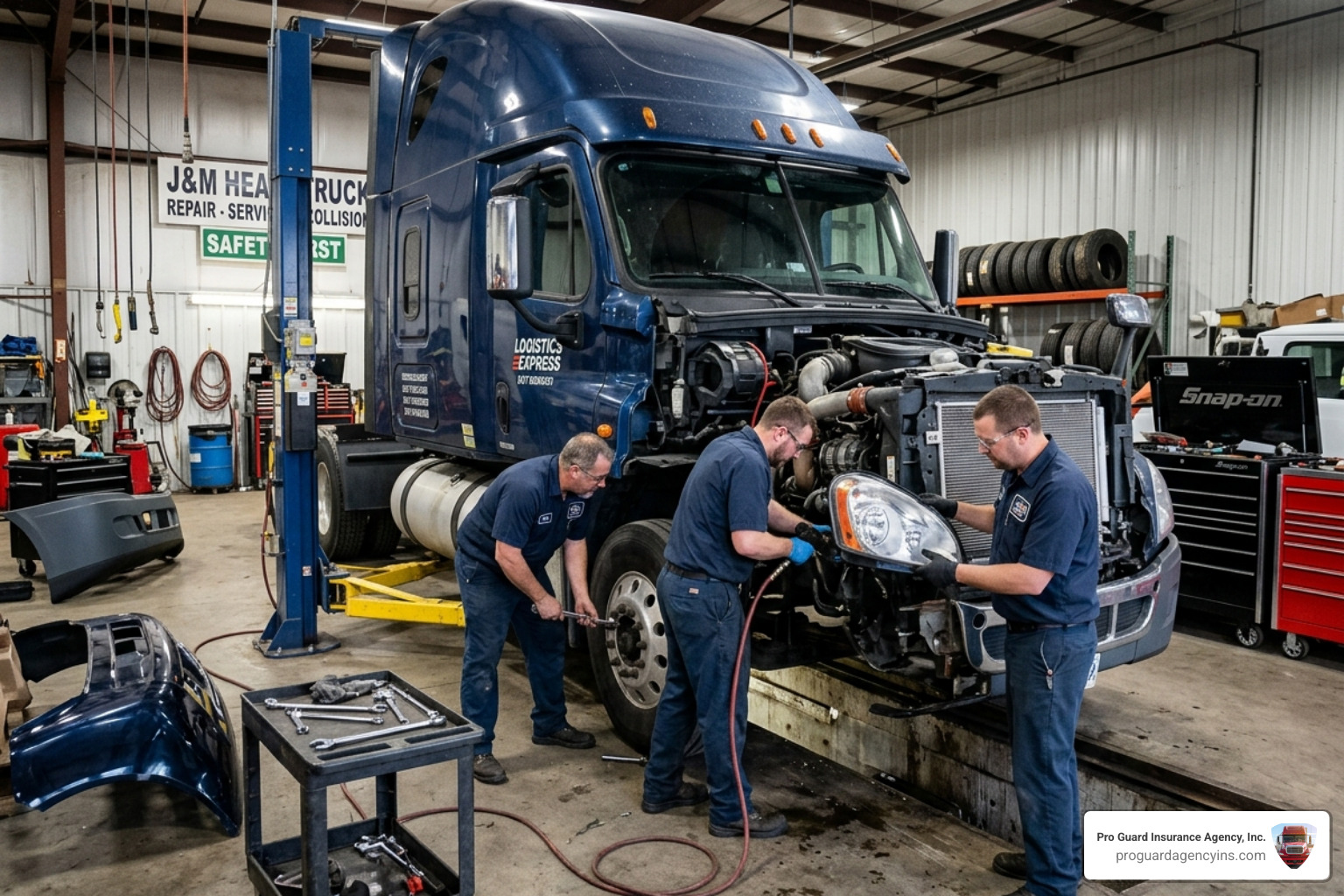
When we talk about physical damage insurance trucking, we are referring to a group of coverages designed to protect your most valuable business assets: your tractor and your trailer. Unlike liability insurance, which pays for the damage you cause to others, physical damage insurance is all about taking care of your equipment. It provides 24-hour protection for your rig, whether it is cruising down the I-90, parked at a rest stop in Illinois, or sitting in a garaging facility in Florida.
Think of this as the “health insurance” for your truck. If your vehicle is damaged in an accident or stolen, this policy steps in to cover the repair costs or provide a settlement for the vehicle’s value so you can get back to work. While you are focusing on the road, we focus on ensuring your capital investment doesn’t vanish overnight. For a deeper look at how this fits into your broader insurance portfolio, check out A Broker’s Guide to Not Losing Sleep Over Cargo Insurance to see how vehicle protection and cargo protection work hand-in-hand.
Who Needs Physical Damage Insurance Trucking?
If you own or operate a commercial vehicle, you likely need this coverage. Specifically, it is essential for:
- Owner-Operators: Your truck is your livelihood. If it’s out of commission, your income stops. Even if you are leased onto a motor carrier that provides primary liability, they rarely cover the physical damage to your unit.
- Fleet Managers: For fleets operating tractors less than 10 years old or valued above $25,000, physical damage coverage is a standard requirement to protect the company’s balance sheet.
- Financed or Leased Vehicles: If you don’t own your truck outright, your lender or leasing company will absolutely insist on this coverage to protect their financial interest in the asset.
- Lease-Purchase Drivers: Most contracts for lease-purchase programs mandate that the driver carries comprehensive and collision coverage.
Legal vs. Contractual Requirements
Here is a point of confusion we often clear up for our clients: physical damage insurance trucking is not legally mandated by the FMCSA or any U.S. state. The government only cares that you have enough public liability insurance (ranging from $750,000 to $5 million) to pay for damages to others.
However, just because the law doesn’t require it doesn’t mean you can skip it. Most truckers face contractual requirements. If you have a loan, the bank is the “lienholder” or “loss payee.” They will require proof of insurance before you even drive off the lot. Without it, you are in breach of your loan agreement. Furthermore, if you are an independent contractor, the companies you pull for may require you to have this coverage to ensure their operations aren’t stalled by your equipment failures.
Collision vs. Comprehensive: The Pillars of Protection
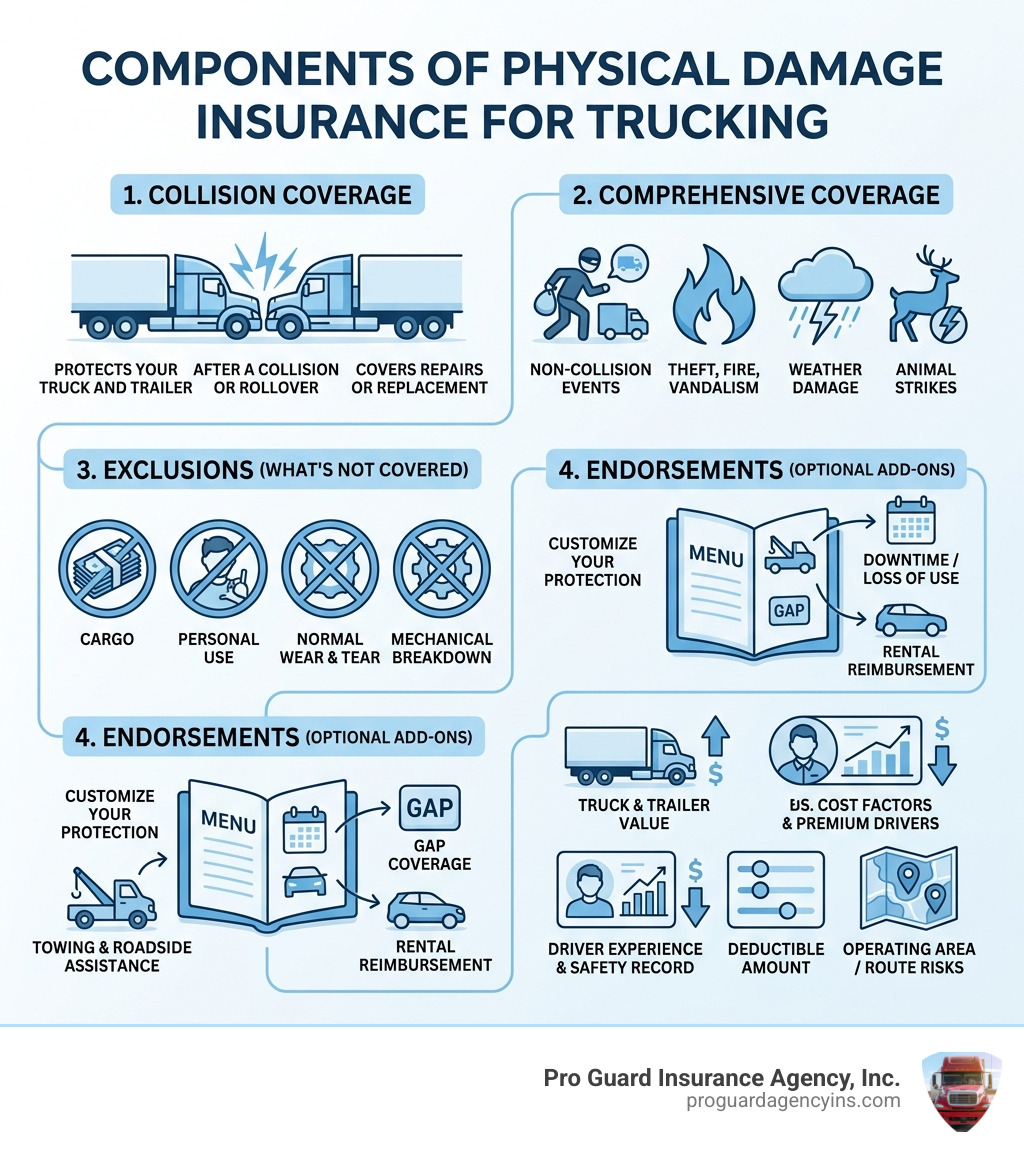
To truly understand your policy, you have to look at the two main pillars: Collision and Comprehensive. These are typically sold together to provide full physical damage protection.
Collision Coverage Explained
Collision coverage is exactly what it sounds like. It pays for damage to your truck when it hits another object or vehicle. This includes:
- Accidents with other vehicles: Whether it’s a fender bender in a parking lot or a highway pileup.
- Object strikes: Hitting a telephone pole, a guardrail, or a bridge.
- Overturns and Rollovers: If the truck tips over due to high winds or taking a corner too fast, collision coverage handles the frame and body repairs.
Comprehensive and Specified Perils
Comprehensive coverage handles almost everything else—the “acts of God” and external risks that don’t involve a collision. This includes:
- Theft and Vandalism: If your rig is stolen from a yard or spray-painted by vandals.
- Natural Disasters: Damage from fire, hail, windstorms, earthquakes, or floods.
- Animal Strikes: Hitting a deer is a common and expensive reality for long-haul truckers; comprehensive covers this.
For those looking to save a bit on premiums, there is an alternative called Fire and Theft with Combined Additional Coverage (CAC). This is a more limited form of comprehensive insurance. It covers specific events like fire, lightning, and theft, but it notably excludes glass breakage and windshield claims. If you are operating a heavy truck in a low-risk area, this might be an option, but for most, full comprehensive is the safer bet. For those driving without a trailer, you might also want to read Bobtail Insurance Explained: Protecting Your Rig Without the Trailer to see how your coverage changes when you aren’t under dispatch.
Common Policy Exclusions
No insurance policy covers everything. It is vital to know the gaps so you aren’t surprised during a claim. Standard physical damage insurance trucking policies typically exclude:
- Wear and Tear: Rust, old tires, and general deterioration are your responsibility.
- Mechanical or Electrical Breakdown: If your transmission blows or your ELD glitches out, that is a maintenance issue, not an insurance claim.
- Driver Dishonesty: If a driver steals the truck or intentionally damages it, most policies won’t pay.
- Cargo Damage: This is the big one. Physical damage insurance protects the truck, not what’s inside it. For that, you need Motor Truck Cargo insurance.
- Personal Items: Your laptop, clothes, and microwave inside the cab aren’t covered unless you add a specific endorsement.
If you are also managing employees, don’t forget that physical damage doesn’t cover injuries. For that, see our Don’t Get Left in the Dust: Florida Trucking Workers Comp Guide.
Valuation Methods: Don’t Get Shortchanged in a Total Loss
How much will the insurance company actually pay if your truck is totaled? This is where many truckers get a rude awakening. There are two primary ways a truck’s value is determined.
| Feature | Actual Cash Value (ACV) | Stated Amount / Stated Value |
|---|---|---|
| Definition | Market value at the time of loss | An amount you “state” as the value |
| Depreciation | Fully applied based on age/mileage | Applied at time of loss |
| Payout Limit | The lesser of repair cost or ACV | The lesser of ACV or Stated Amount |
| Best For | Newer trucks with standard equipment | Custom rigs with many add-ons |
Actual Cash Value (ACV)
Most standard policies default to Actual Cash Value. This means the insurer looks at the market value of your truck the moment before the crash. They factor in depreciation, mileage, and wear. If you bought a tractor for $150,000 three years ago, its ACV today might only be $90,000. That is all the insurance company will pay, minus your deductible. For more on this, read Don’t Get Depreciated by Your Actual Cash Value Policy.
Stated Amount and Agreed Value
With a Stated Amount policy, you provide an estimate of the vehicle’s value when you sign up. This should include permanently attached equipment like APUs, custom chrome, or specialized liftgates. However, be careful: a stated amount is usually a maximum cap on the payout, not a guaranteed check. The insurer will still only pay the ACV if the ACV is lower than your stated amount. It is crucial to schedule your VINs correctly and update these values annually to reflect the real market.
Beyond the Basics: Essential Endorsements for Physical Damage Insurance Trucking
A basic policy gets you back on the road, but “Basic” doesn’t pay the bills while your truck is in the shop. That is where endorsements (add-ons) come in.
Downtime and Rental Reimbursement
When your truck is down, your revenue is zero. Downtime coverage can be a lifesaver. Some policies provide a benefit of around $450 per week for a maximum of eight weeks while repairs are being made. There is often a 35-day waiting period before this kicks in, so it’s designed for major repairs, not overnight fixes.
Rental reimbursement is slightly different. It helps pay for the cost of renting a replacement tractor so you can keep hauling loads. These benefits can sometimes cover rental costs for up to 120 days, depending on the carrier.
Gap Coverage for Financed Rigs
Trucks depreciate fast. It is very common to owe $100,000 on a loan for a truck that is only “worth” $85,000 on the open market. If that truck is totaled, the insurance company pays $85,000, leaving you with a $15,000 bill to the bank for a truck you no longer have. Gap coverage (or Finance Value Coverage) pays that difference, ensuring you don’t start your next venture in a deep financial hole.
Customizing Your Physical Damage Insurance Trucking Policy
At Pro Guard, we often suggest bundling specific protections into your policy:
- Tarps, Chains, and Binders: These are expensive tools of the trade. We can ensure they are covered if they are stolen or damaged in a collision.
- Electronic Equipment: Coverage for your GPS, ELD, and high-end communication radios.
- Diminishing Deductibles: A reward for safe driving. For every year you go without a claim, your deductible drops (sometimes by 25% per year) until it reaches zero.
- Combined Deductible: If an accident damages your tractor, your trailer, and your cargo, a combined deductible ensures you only pay one deductible instead of three.
For those operating smaller units, you might find our guide on How to Insure Your Box Truck Without Breaking the Bank helpful for tailoring these endorsements.
Factors Influencing Your Physical Damage Insurance Trucking Premiums
How much will this cost? On average, the annual premium for physical damage insurance trucking is between 3% and 5% of the truck’s value. If your truck is worth $100,000, expect to pay between $3,000 and $5,000 per year. However, several factors can move that needle.
How Deductibles Work
The deductible is your “skin in the game”—the amount you pay out of pocket before the insurance kicks in. In the trucking world, deductibles are higher than personal auto policies. Common amounts range from $2,500 to $5,000.
Choosing a higher deductible is the fastest way to lower your monthly premium. If you can afford to keep $5,000 in a “rainy day” fund, opting for a $5,000 deductible could save you hundreds of dollars in annual premiums compared to a $1,000 deductible.
Strategies to Lower Your Costs
We always look for ways to help our clients save. Here are the most effective strategies:
- Safety Technology: Many carriers offer discounts for trucks equipped with dash cams, GPS tracking, and collision-avoidance systems.
- Clean MVRs: Your driving record (and the records of your drivers) is the biggest factor. A clean Motor Vehicle Record (MVR) suggests lower risk.
- Secure Garaging: Where you park matters. If your truck is kept in a fenced, monitored lot in a low-crime ZIP code, your comprehensive rates will be lower.
- Experienced Drivers: Hiring drivers with 2+ years of CDL experience significantly reduces premiums.
Frequently Asked Questions about Physical Damage Insurance Trucking
Is physical damage insurance legally required?
No, it is not required by federal or state law. However, it is almost always required by lenders if you have a loan or lease on the vehicle. Even if you own your truck outright, we highly recommend it because the cost of a total loss is usually enough to bankrupt a small trucking business.
How is the value of my truck determined?
Most policies use Actual Cash Value (ACV), which is the fair market value at the time of the loss. You can also use a Stated Amount, which sets a maximum limit for the payout based on your estimate of the truck’s value, including custom equipment.
Does physical damage cover my cargo or personal items?
Standard policies do not cover cargo or personal belongings like laptops and clothes. You need a separate Motor Truck Cargo policy for the freight, and you can often add an endorsement for “Personal Effects” to cover your items inside the cab.
Conclusion
Protecting your rig isn’t just about following a lender’s rules—it’s about securing your future. Physical damage insurance trucking ensures that a single patch of ice or a dishonest thief doesn’t end your career. From collision and comprehensive basics to advanced endorsements like downtime and gap coverage, there are many ways to build a shield around your business.
At Pro Guard Insurance Agency, Inc., we specialize in these complex details. We partner with over 100 carriers and are licensed in 31 states, including Illinois, Florida, Texas, and Ohio, to bring you personalized service that fits your specific route and rig. We’ve been helping truckers since 2017, and we’d love to help you next.
Ready to protect your investment? More info about Pro Guard services is just a click away. Let’s get you covered so you can get back to what you do best: keeping the country moving.