
What General Liability Insurance Really Means for Your Business
General liability insurance is a policy that protects your business from financial losses when a third party — a customer, visitor, or bystander — claims your business caused them harm.
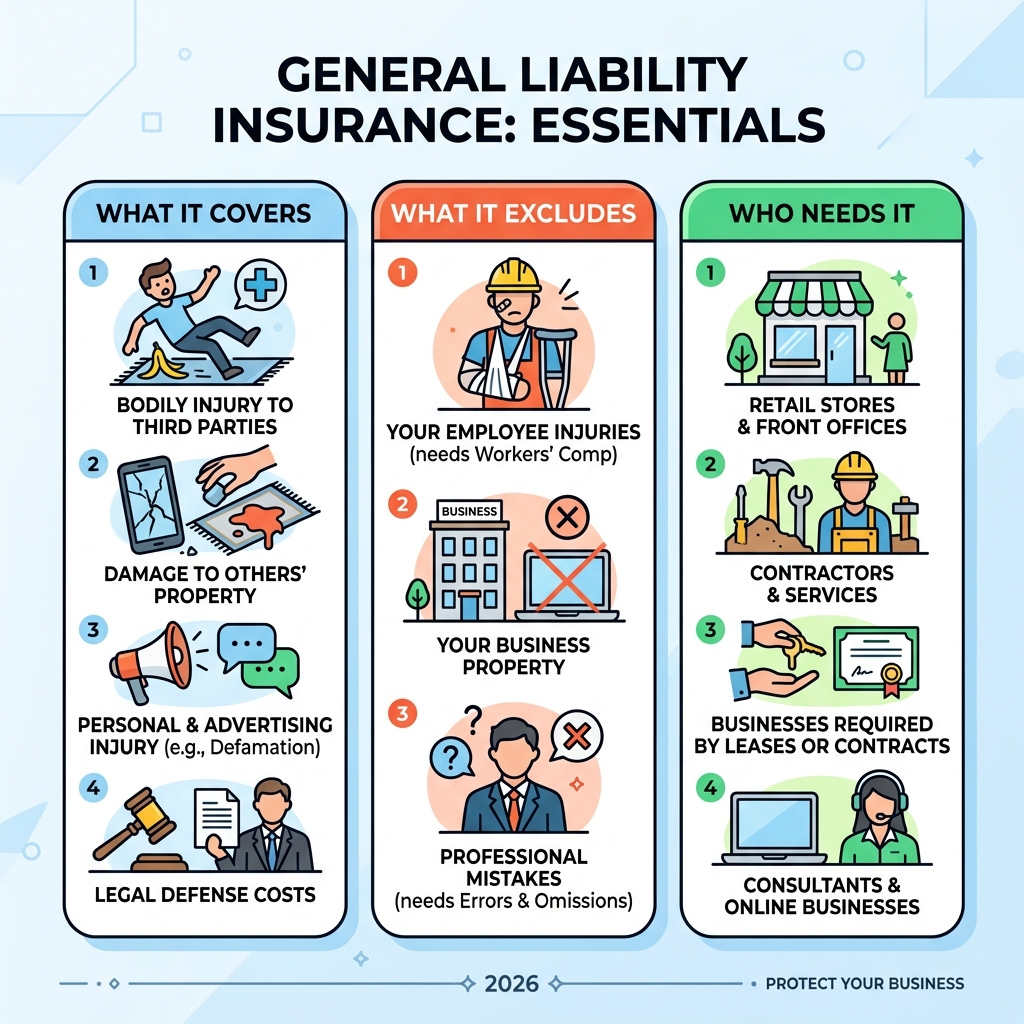
Here’s what it covers at a glance:
| What It Covers | Example |
|---|---|
| Bodily injury to third parties | A customer slips and falls at your location |
| Damage to others’ property | You accidentally damage a client’s equipment |
| Personal and advertising injury | An employee’s social media post leads to a defamation claim |
| Legal defense costs | Attorney fees and court costs, even if you’re not at fault |
It does not cover your own property, your employees’ injuries, or professional mistakes — those need separate policies.
General liability is one of the most common business insurance policies for a reason. Without it, a single lawsuit could cost your business tens of thousands of dollars — or more. Many clients, landlords, and licensing boards won’t even work with you unless you can show proof of coverage.
I’m Anna Domagala, co-founder of Pro Guard Insurance Agency, Inc., where I’ve helped hundreds of businesses — including commercial trucking operators — find the right general liability insurance to protect their livelihoods. In the guide below, I’ll walk you through everything you need to know, from what’s covered to what it costs.
What is General Liability Insurance?
Commonly referred to as Commercial General Liability (CGL), general liability insurance serves as the bedrock of a business’s risk management strategy. Think of it as a financial safety net that catches your business when things go wrong during everyday operations. Whether you operate out of a storefront in Inverness, IL, or manage a fleet of trucks across Texas, this coverage is designed to handle claims made by “third parties”—that is, anyone who isn’t you or your employees.
The primary goal of a CGL policy is to protect your business assets from being drained by legal fees and settlement costs. If a visitor trips over a loose rug at your office or a technician accidentally knocks over an expensive vase while working at a client’s home, the resulting medical bills or repair costs could easily reach five or six figures.
Beyond physical accidents, general liability insurance also covers “personal and advertising injury.” This includes non-physical harm like libel, slander, or even copyright infringement in your marketing materials. One of the most valuable aspects of this policy is that it covers your legal defense costs. Even if a claim against you is completely groundless, the cost of hiring a lawyer to prove your innocence can be staggering. Your policy steps in to pay those attorney fees, court costs, and any settlements or judgments up to your policy limits.
At Pro Guard Insurance Agency, we know that every business has a unique risk profile. That’s why we offer more info about our insurance services to help you tailor your protection to your specific industry needs.
Who Needs General Liability Insurance Coverage?
The short answer? Almost everyone. If your business interacts with the public in any capacity—whether you have a physical office, visit client sites, or sell products—you likely need general liability insurance.
Consider these common professions that rely on this coverage:
- Artisan Contractors: Plumbers, electricians, and carpenters who work on other people’s property face daily risks of accidental damage.
- Landscapers: From a rock flying out of a mower and hitting a window to a passerby tripping over a tool, the outdoors is full of liability.
- IT Consultants: While you might work mostly on a computer, visiting a client’s server room or hosting them at your office creates a physical liability risk. Interestingly, some policies for IT professionals even include electronic data liability for certain third-party data losses.
- Real Estate Agents: Hosting open houses means constant foot traffic from the public, significantly increasing the risk of slip-and-fall accidents.
- Cleaning Businesses: Working inside private homes or commercial buildings means you are responsible for the property around you.

Beyond personal choice, there are external pressures that make this coverage a “must-have.” Many client contracts explicitly require you to carry a certain amount of liability insurance before you can even step foot on a job site. Similarly, lease requirements from landlords often mandate a CGL policy to protect the building owner from accidents occurring within your rented space. Furthermore, many professional licenses—especially for contractors in states like Florida or Illinois—cannot be obtained or renewed without proof of insurance.
If you’re looking for local expertise, our Insurance Agency Inverness team is here to help you navigate these requirements.
Understanding What General Liability Insurance Covers
To truly understand general liability insurance, we need to break down the “Coverage A, B, and C” structure often found in these policies.
- Bodily Injury (Coverage A): This is the “slip-and-fall” protection. If a customer breaks a wrist at your shop, your policy covers their medical expenses, lost wages, and your legal defense if they sue.
- Property Damage (Coverage A): This covers damage you cause to someone else’s property. For example, if a painter spills a gallon of “Midnight Blue” on a client’s white Persian rug, this coverage handles the replacement cost.
- Personal and Advertising Injury (Coverage B): This protects you from lawsuits involving libel, slander, or disparaging a competitor’s products. It also covers copyright infringement—for instance, if you accidentally use a protected image in your brochure without permission.
- Medical Payments (Coverage C): This is often called “goodwill” coverage. it pays for minor medical expenses (usually up to $5,000) for a third party injured on your premises, regardless of who was at fault. It’s a great way to settle small issues quickly before they turn into major lawsuits.
Another critical component is Products-Completed Operations. This protects you if your work causes damage after the job is finished. If a plumber installs a water heater and it leaks three weeks later, ruining the floor, this part of the policy covers the damage.
| Feature | Bodily Injury | Property Damage | Advertising Injury |
|---|---|---|---|
| What is it? | Physical harm to a person | Physical damage to tangible items | Non-physical harm to reputation/rights |
| Example | Customer trips on a cord | You break a client’s window | Sued for a “stolen” logo design |
| Key Inclusion | Medical bills & legal fees | Repair or replacement costs | Legal defense & settlements |
Key Exclusions: What is Not Covered?
While general liability insurance is broad, it isn’t a “catch-all” for every business problem. Understanding the gaps is just as important as knowing the coverage.
First and foremost, employee injuries are never covered by general liability. If your assistant falls off a ladder, you need a separate Workers’ Compensation policy. Most states where we operate, including Alabama, Georgia, and Pennsylvania, have strict legal requirements for workers’ comp if you have even one employee.
Second, professional negligence (errors and omissions) is excluded. If you are an architect and your building design is flawed, or if you are a consultant and give advice that loses a client money, that is a “professional liability” claim. You’ll need a Professional Liability (or Errors & Omissions) policy for that.
Third, your business-owned property is not covered. If a fire destroys your office equipment, laptops, or tools, your general liability policy won’t pay a dime because that property belongs to you, not a third party. For this, you need Commercial Property insurance.
Finally, commercial auto accidents are excluded. If you or an employee causes a wreck while driving for business, your CGL policy will not cover the vehicle damage or injuries. To stay protected on the road, you can learn about car and motor insurance options that complement your liability coverage.
Factors That Influence Your Insurance Costs
We often get asked, “How much does general liability insurance cost?” While the national median is around $60 per month, the reality is that your premium is as unique as your thumbprint.
Several factors go into the “secret sauce” of insurance pricing:
- Industry Risk: A roofer or a trucking company faces significantly higher risks than a bookkeeper. For example, construction professionals often pay an average of $82 per month, while low-risk consultants might pay as little as $19 to $30 per month.
- Business Location: Operating in a high-traffic area or a state with a history of expensive lawsuits (like New York or Florida) can drive premiums up.
- Number of Employees: More people working for you generally means more opportunities for something to go wrong.
- Coverage Limits: A policy with a $2 million limit will naturally cost more than one with a $300,000 limit. Most small businesses opt for a standard $1 million per occurrence / $2 million aggregate limit.
- Deductibles: Choosing a higher deductible (the amount you pay out of pocket) can lower your monthly premium, but you must ensure you have that cash on hand if a claim occurs.
- Claims History: If you’ve had multiple claims in the past, insurers may view you as a higher risk and charge more.
To get a precise number for your specific situation, we invite you to request a quote for your business. We partner with over 100 carriers to find the best fit for your budget.
Frequently Asked Questions about Business Liability
Is general liability insurance required by law?
Technically, general liability insurance is not mandated by federal law in the same way that workers’ compensation or commercial auto insurance often is. However, that doesn’t mean it’s optional in the real world.
In many states, such as California or Illinois, specific licensing boards require contractors to carry liability insurance to maintain their professional license. Furthermore, contractual obligations are the most common driver for this insurance. If you want to bid on a government project or work for a large corporation, they will almost certainly require you to have a policy in place before the contract is signed.
What is a Certificate of Insurance (COI)?
A Certificate of Insurance (COI) is a one-page document that summarizes your insurance coverage. It’s essentially your “proof of insurance.” It lists your policy numbers, coverage limits, and effective dates.
When you are in the bidding process for a new job, a potential client will likely ask for an ACORD form (the industry standard for COIs). Providing this quickly shows that you are a professional, insured business, giving you a competitive edge. At Pro Guard, we pride ourselves on getting these documents to our clients quickly so they never miss a business opportunity. You can learn more about our agency and how we support our clients’ growth.
Can I bundle general liability with other policies?
Absolutely! In fact, we highly recommend it. For small to medium-sized businesses in low-risk industries, a Business Owner’s Policy (BOP) is a fantastic option. A BOP bundles general liability insurance with commercial property insurance and business interruption insurance into one package.
Bundling usually results in significant cost savings compared to buying each policy separately. It also simplifies your life by giving you one premium to pay and one renewal date to remember. If you’re unsure if you qualify for a BOP, speaking with an Insurance Broker Inverness specialist can help you determine the most cost-effective path.
Conclusion
Protecting your business shouldn’t feel like a guessing game. General liability insurance is the foundation upon which a secure business is built. It guards against the “what-ifs” of daily operations, ensuring that one accident doesn’t lead to a permanent “Closed” sign on your door.
At Pro Guard Insurance Agency, Inc., we’ve been dedicated to personalized service since 2017. Whether you are a local contractor in Inverness or a long-haul trucker licensed in one of the 31 states we serve—from Texas to Michigan and beyond—we are here to help. With access to over 100 carriers, we don’t just sell you a policy; we find the right policy for your specific risks.
Don’t wait for a claim to happen before you think about protection. Protect your business with our comprehensive services today and gain the peace of mind that comes with knowing we’ve got your back. Reach out to us for a customized quote and let’s secure your future together.