
What Does Bobtail Insurance Actually Cost Per Month?
How much is bobtail insurance per month is a straightforward question with a clear answer for most owner-operators:
| Coverage Level | Monthly Cost | Annual Cost |
|---|---|---|
| Standard ($1M liability limit) | $30 – $60 | $360 – $720 |
| Higher limits ($1M – $2M) | $45 – $85 | $540 – $1,020 |
| Overall typical range | $20 – $150 | $240 – $1,800 |
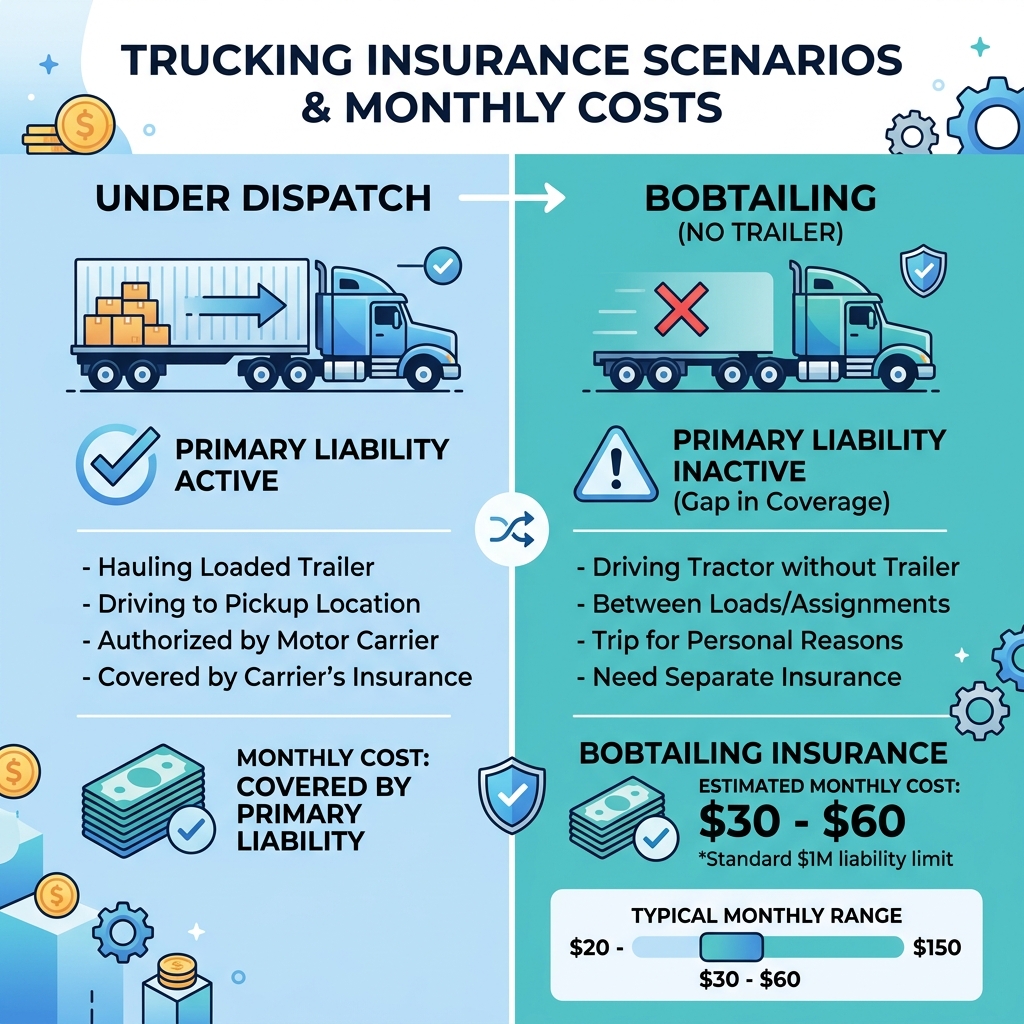
Most owner-operators pay between $30 and $60 per month for a standard $1M bobtail liability policy. A realistic average for a single-truck operation lands around $35-$47 per month.
That said, your exact rate depends on factors like your driving record, location, and how often you drive without a trailer.
Here’s the problem bobtail insurance solves: your primary liability coverage only protects you while you’re under dispatch or hauling a trailer. The moment you drop a load and head to your next pickup — without a trailer attached — that coverage goes dark.
That gap is called bobtailing, and it’s more common than most truckers realize. Every trip between deliveries, every drive to pick up your first load of the day, every repositioning move — those miles are unprotected without a separate bobtail policy.
For independent contractors leased to a motor carrier, this isn’t just a risk management issue. Most carriers require you to carry bobtail coverage as a condition of your lease agreement.
The good news? It’s one of the most affordable commercial trucking coverages available.
How Much is Bobtail Insurance Per Month?
When we look at the national landscape for trucking insurance, bobtail coverage stands out as a relatively small expense that offers massive peace of mind. While the broad range for how much is bobtail insurance per month spans from $20 to $150, the vast majority of drivers we work with find themselves in the $30 to $60 sweet spot.
If you are looking for a standard $1 million liability limit—which is the industry benchmark required by most motor carriers—you can expect to pay roughly $350 to $600 per year. When broken down, that is less than the cost of a couple of steak dinners a month to protect your entire livelihood.
Get a Quote for Bobtail Insurance
It is important to note that “bobtail” refers specifically to operating the tractor (the “horse”) without the trailer (the “cart”). Because you are operating a smaller, lighter configuration, the premiums are significantly lower than primary liability insurance, which can easily cost $350 to $1,000+ per month. However, if you opt for higher limits—say, $2 million in coverage—your monthly premium might jump into the $45 to $85 range.
At Pro Guard Insurance Agency, we often see variations based on the specific needs of the driver. A sample quote for a single truck and driver in a state like New Jersey might hover around $47 per month, whereas a driver in a less congested area with a pristine record might see rates closer to $30.
Key Factors Influencing Your Monthly Bobtail Insurance Rate
Insurance companies don’t just pull numbers out of a hat. When determining how much is bobtail insurance per month for your specific operation, underwriters look at several “risk levers.”
Driving History and CDL Experience
Your Motor Vehicle Record (MVR) is the biggest driver of cost. A clean record with no accidents or speeding tickets over the last three to five years will always net you the lowest rates. Furthermore, experience matters. Most insurers prefer drivers with at least two years of CDL experience; if you are a “new venture” or a fresh driver, expect to pay on the higher end of the scale until you’ve proven your safety on the road.
Garaging Location
Where you park your truck matters. Insurance rates are heavily influenced by the litigation environment and accident frequency of your home state. For our clients in high-traffic states like Illinois, New Jersey, or Texas, rates may be slightly higher than for those garaged in North Dakota or Iowa.
Truck Make and Vehicle Age
While bobtail insurance is a liability coverage (meaning it pays for damage you do to others), the type of truck you drive still influences the rate. Newer trucks equipped with advanced safety features often qualify for discounts. Conversely, a heavier or more powerful tractor might carry a slightly higher liability risk.
The Science of the “Bobtail” Risk
There is a scientific reason why bobtail insurance is a separate, vital category. According to research on bobtail truck braking power, semi-trucks are actually harder to stop when they don’t have a trailer. Most of a tractor’s braking power is located in the rear axles. Without the weight of a loaded trailer pressing down on those axles, the tires have less traction, making the truck more prone to skidding or jackknifing during a hard brake.

Operating Radius and Business Size
If you only bobtail within a 50-mile radius of your home base, your risk is lower than a driver who frequently bobtails long distances between states. Similarly, if you operate a small fleet, you may be able to secure “volume” pricing that reduces the per-unit cost compared to a single owner-operator.
Bobtail vs. Non-Trucking Liability: Understanding the Cost Difference
One of the most common points of confusion in the trucking world is the difference between Bobtail Insurance and Non-Trucking Liability (NTL). While they sound similar, they cover different “triggers,” and this affects how much is bobtail insurance per month.
Comparing how much is bobtail insurance per month vs. NTL
- Bobtail Insurance: Covers you when you are operating a tractor without a trailer, regardless of whether you are on business or personal time. It fills the gap when you are between loads or heading to a terminal.
- Non-Trucking Liability (NTL): Covers you for “personal use” only. This means if you take the truck to the grocery store or a movie on your day off, NTL kicks in. However, NTL typically does not cover you if you are bobtailing for a business purpose (like heading to pick up a load).
Because NTL has a narrower “personal use” trigger, it is often slightly cheaper, ranging from $25 to $50 per month. However, many lease agreements specifically demand Bobtail coverage because it offers broader protection during those “gray area” business miles.
More info about commercial trucking services
Why bobtail insurance is essential for leased operators
If you are leased to a motor carrier, their primary liability policy usually covers you from the moment you “hook up” to a trailer until you “drop” it. But what happens in between?
According to Federal Motor Carrier Safety Administration accident data, bobtail trucks are actually overrepresented in serious accidents. Because they are lighter and harder to handle, the risk of a third-party lawsuit is high. Bobtail insurance provides the legal defense and settlement funds needed if you cause an accident while “running light.” Without it, a single fender-bender could result in thousands of dollars in out-of-pocket legal fees and medical payments.
Strategies to Lower Your Bobtail Insurance Premiums
We know that every dollar counts in the trucking business. If you’re looking to trim down how much is bobtail insurance per month, there are several proven strategies to lower your overhead.
How to get the lowest rate for how much is bobtail insurance per month
- Bundle Your Policies: This is the “Golden Rule” of insurance. If you get your Bobtail, NTL, Physical Damage, and Cargo insurance through the same agency, you can often secure a multi-policy discount of 10% to 20%.
- Pay Annually: Most carriers charge “installment fees” for monthly payments. By paying your premium in full for the year, you can often save 5% to 10% right off the top.
- Invest in Safety Technology: Modern trucks are safer than ever. Equipping your cab with dashcams, telematics (like ELDs that track safety data), and collision avoidance systems can make you much more attractive to underwriters. Some programs, like Smart Haul, can save drivers over $1,000 a year on their total insurance package.
- Maintain a Clean MVR: It sounds simple, but a single speeding ticket can hike your rates for three years. Staying compliant and attending defensive driving courses can keep you in the “preferred” pricing tier.
- Adjust Your Deductibles: While bobtail liability itself usually doesn’t have a deductible, the companion policies you bundle with it (like Physical Damage) do. Choosing a higher deductible on your truck’s physical damage can lower the overall monthly cost of your insurance bundle.
Frequently Asked Questions about Bobtail Insurance
Is bobtail insurance legally required?
Technically, the FMCSA does not mandate bobtail insurance; they only require primary liability. However, almost every motor carrier lease agreement does require it. If you want to work for a reputable carrier, you will need to show proof of bobtail or NTL coverage. It is a contractual requirement that protects both you and the carrier from gaps in coverage.
Does bobtail insurance cover damage to my own truck?
No. This is a major misconception. Bobtail insurance is a liability-only policy. It pays for the other person’s medical bills and car repairs if you are at fault. To cover your own truck for theft, fire, or collision damage, you need Physical Damage Insurance. At Pro Guard Insurance Agency, we recommend pairing these two together for full protection.
What is the difference between bobtail and deadhead coverage?
These terms are often used interchangeably, but they are different. “Deadheading” means you are pulling an empty trailer. In most cases, deadheading is covered by your carrier’s primary liability insurance because you are still “under dispatch.” Bobtailing means you have no trailer at all. Once the trailer is unhooked, your primary liability usually stops, and bobtail insurance must take over.
Conclusion
Understanding how much is bobtail insurance per month is the first step toward protecting your trucking business. While the average cost of $30 to $60 per month is modest, the protection it provides against catastrophic lawsuits is immeasurable.
At Pro Guard Insurance Agency, we specialize in helping owner-operators navigate these complex requirements. Whether you are operating in Illinois, Texas, Florida, or any of the 31 states where we are licensed, our team is dedicated to finding you the best rates through our partnerships with over 100 carriers. We don’t just sell policies; we provide personalized service to ensure you never have a gap in your coverage.
Ready to see exactly what your rate will be? Don’t leave your livelihood to chance.