
What Does Contingent Cargo Insurance for Freight Brokers Cost?
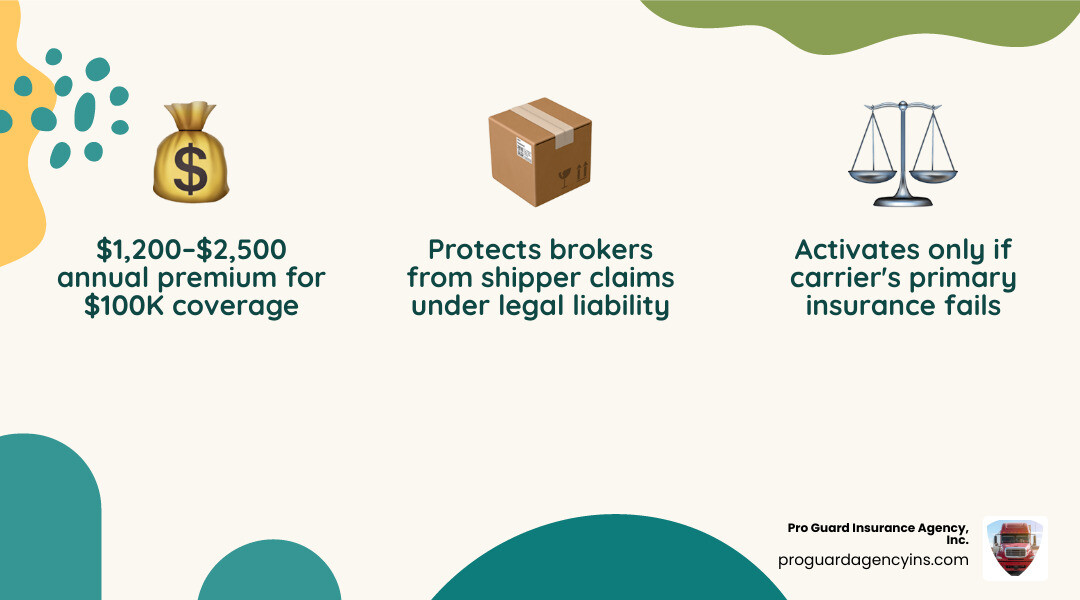
Contingent cargo insurance for freight brokers cost typically falls between $1,200 and $2,500 per year for a standard $100,000 per-load coverage limit. Here’s a quick breakdown:
| Brokerage Size | Typical Annual Cost | Monthly Equivalent |
|---|---|---|
| Smaller brokerages | $1,500 – $2,000 | ~$125 – $167 |
| Most freight brokers | $1,200 – $2,500 | ~$100 – $208 |
| Budget providers (e.g., per-load options) | From ~$840 | From ~$70 |
Costs vary based on coverage limits, cargo type, claims history, and gross revenue.
As a freight broker, you sit in the middle — between shippers and carriers. You don’t touch the cargo. You don’t drive the truck. So why would you need insurance if something goes wrong?
Here’s the hard truth: if a carrier’s policy is denied, lapses, or simply doesn’t cover the full loss, shippers can — and do — come after the broker. That’s exactly the gap contingent cargo insurance is designed to fill.
It’s a backstop. A safety net. And for most brokers, it’s one of the more affordable protections they can buy.
I’m Anna Domagala, co-founder of Pro Guard Insurance Agency, Inc., where I’ve spent years helping commercial trucking and freight brokerage businesses navigate the true contingent cargo insurance for freight brokers cost — and find coverage that fits their budget without leaving them exposed. In the sections below, I’ll walk you through everything you need to know to estimate your costs and make a smart decision.
Understanding Contingent Cargo Insurance for Freight Brokers
To understand the cost, we first have to look at what you are actually paying for. In the insurance world, we talk a lot about “care, custody, and control.” As a broker, you never have physical control of the goods. However, you do have legal liability.
What Is Contingent Cargo Insurance for Freight Brokers? It is a secondary form of coverage. Think of it as a backup generator. If the motor carrier’s primary insurance fails to pay out—perhaps because they let their policy lapse, they violated a warranty in their fine print, or the claim exceeds their limits—your contingent policy kicks in to protect your business from the fallout.
The legal landscape has shifted over the years. Thanks to the 1994 Interstate Commerce Act and various interpretations of the Carmack Amendment, the definition of “transportation” now includes the arrangement of freight. This means brokers can be hit with vicarious liability. If a carrier you hired causes a massive loss and their insurance fails, the shipper’s lawyers will look for the next deep pocket: yours.
How Contingent Cargo Insurance for Freight Brokers Cost is Justified
We often hear from new brokers who ask, “If I vet my carriers perfectly, why do I need this?” While vetting is vital, it isn’t foolproof. A carrier might have a valid certificate of insurance (COI) when you book the load, but if they haven’t paid their premium, that policy could be cancelled by the time the truck hits the highway.
A Broker’s Guide to Not Losing Sleep Over Cargo Insurance highlights that this coverage is more than just a defensive move; it’s a growth tool. Many high-quality shippers won’t even look at your contract if you don’t carry contingent cargo insurance. By paying that annual premium, you are buying:
- Client Trust: You are showing shippers you have the financial backing to make them whole.
- Risk Mitigation: You protect your personal and business assets from unpredictable carrier failures.
- Professional Reputation: Being “fully insured” is a badge of honor in the logistics world.
Breaking Down the Contingent Cargo Insurance for Freight Brokers Cost
Now, let’s talk numbers. For most of our clients at Pro Guard Insurance Agency, the contingent cargo insurance for freight brokers cost is surprisingly manageable. While the average freight broker in the U.S. might pay between $3,000 and $3,600 per year for their entire insurance package (including bonds and liability), the contingent cargo portion is usually a fraction of that.
As we noted in the intro, the standard range for a $100,000 limit is $1,200 to $2,500 per year. For smaller operations or those just starting out, we often see quotes in the $1,500 to $2,000 range. If you prefer to manage cash flow monthly, some specialized providers offer rates as low as $70 per month, which totals roughly $840 annually.
| Pricing Model | Estimated Cost | Best For |
|---|---|---|
| Annual Premium | $1,200 – $2,500 | Established brokers with steady volume |
| Monthly Payments | $70 – $200/mo | New brokers managing startup capital |
| Per-Load Pricing | Varies by value | Spot market brokers with infrequent loads |
Factors Influencing Your Contingent Cargo Insurance for Freight Brokers Cost
Why does one broker pay $1,200 while another pays $2,500? Insurance companies use a variety of “rating factors” to determine your risk level.
- Gross Revenue: Generally, the more freight you move, the higher your exposure. Most policies are rated based on your projected annual gross brokerage revenue.
- Commodity Type: Are you moving gravel or electronics? Shipping “target commodities” like liquor, high-end electronics, or pharmaceuticals will drive up your contingent cargo insurance for freight brokers cost because these items are more prone to theft.
- Coverage Limits: A $100,000 limit is the industry standard, but if you frequently move loads worth $250,000 or more, you’ll need higher limits, which comes with a higher premium.
- Deductibles: Choosing a $1,000 deductible will result in a higher premium than choosing a $2,500 or $5,000 deductible.
- Claims History: If you have a history of cargo claims, underwriters will view you as higher risk.
- Carrier Vetting Protocols: Some insurers will actually give you better rates if you can prove you use rigorous software and procedures to verify carrier authority and insurance.
Coverage Limits and Common Exclusions
When you look at a policy, you’ll see two main numbers: the per-occurrence limit and the aggregate limit. A standard policy usually offers $100,000 per occurrence. This means the most the policy will pay for a single accident or theft is $100,000. The aggregate limit (often $500,000) is the most the policy will pay out during the entire one-year policy period.
It is also important to understand the “form” of the policy.
- Following-Form: This policy only covers what the carrier’s primary policy covers. If the carrier’s policy has a “reefer breakdown” exclusion, your contingent policy won’t cover it either.
- Non-Following Form (Broad Form): This is generally preferred. It sets its own terms and can fill gaps even if the carrier’s policy had specific exclusions.
One of the biggest benefits of these policies is that they typically cover defense costs. If a shipper sues you over a damaged load, the legal fees alone could bankrupt a small brokerage. Your insurance provider will often step in to provide legal counsel and cover those fees, which are usually “outside the limit” (meaning they don’t eat into your $100,000 coverage).
Standard Limits for Contingent Cargo Insurance for Freight Brokers Cost Planning
When planning your budget, don’t just look at the premium. Look at the deductible. Most contingent cargo policies carry a deductible between $1,000 and $2,500. You need to ensure you have this cash on hand in the event of a claim.
You also need to be aware of what is not covered. Common exclusions include:
- Acts of War or Terrorism: Standard in almost all commercial policies.
- Intentional Misconduct: If you or your employees intentionally damage goods (obviously!).
- Nuclear Hazards: Hopefully not something you deal with daily.
- Specific High-Risk Items: Unless specifically scheduled, things like fine art, live animals, or currency are often excluded.
- Reefer Breakdown: Some budget policies exclude “loss of refrigeration” unless you pay an additional endorsement fee.
How to Get Accurate Quotes and Save on Premiums
Getting a quote isn’t as scary as it sounds. To get the most accurate contingent cargo insurance for freight brokers cost, you should have an underwriting checklist ready. We typically ask for:
- Your MC (Motor Carrier) or FF (Freight Forwarder) number.
- A 5-year loss history (or a statement that you are new with no losses).
- A copy of your standard broker-carrier agreement.
- Your projected gross revenue for the next 12 months.
Understanding how contingent cargo insurance for freight brokers works involves matching your specific risk to the right carrier. At Pro Guard Insurance Agency, we partner with over 100 carriers, which allows us to shop around for you.
Pro-Tip for Saving Money: Consider bundling. If you buy your contingent cargo, contingent auto liability, and professional liability (Errors & Omissions) from the same provider, you can often secure a multi-policy discount. Also, maintain a clean record! Safety and diligence in carrier selection are your best long-term cost-saving strategies.
Frequently Asked Questions about Broker Insurance
Is contingent cargo insurance legally required?
Technically, no. The FMCSA requires you to have a $75,000 surety bond (BMC-84) or trust fund (BMC-85) to maintain your brokerage authority. They do not mandate contingent cargo insurance at the federal level. However, some states have specific requirements—for example, California has higher liability expectations for certain operations. More importantly, contractual necessity is the real driver. Most shippers simply won’t work with you unless you have it.
How does it differ from primary cargo insurance?
Primary cargo insurance is held by the carrier. They are the “first responder” to a claim. Contingent cargo is the “backup.” There is also something called Shipper’s Interest Insurance, which is an “all-risk” policy that covers the full value of the goods regardless of who is at fault. While contingent cargo protects you (the broker), Shipper’s Interest is often purchased on a per-load basis to protect the shipper’s specific investment.
Can I pay for insurance on a per-load basis?
Yes! For brokers working the spot market or those who only move a few loads a month, per-load insurance is a fantastic option. Using modern digital platforms, you can buy coverage for a specific shipment with a single click. This can be up to five times cheaper than a full annual policy if your volume is low, providing extreme cost efficiency and flexibility.
Conclusion
Navigating the contingent cargo insurance for freight brokers cost doesn’t have to be a headache. Whether you are a “one-man show” or a scaling 3PL, protecting your business from the “what-ifs” of carrier failure is simply good business. For an annual investment that often costs less than a single high-value tire, you gain the peace of mind to grow your brokerage without the constant fear of a catastrophic cargo claim.
At Pro Guard Insurance Agency, we specialize in these exact scenarios. We are licensed in 31 states—including Illinois, Texas, Florida, and Washington—and we pride ourselves on providing personalized service that the big “cookie-cutter” agencies can’t match.
Ready to see your actual numbers? More info about our insurance services is just a click away. We’ll help you assess your risks, vet your needs, and find a policy that keeps your coins in your pocket and your freight on the move.