
Understanding Your Load Securement Insurance Policy and Coverage Options
When we talk about a load securement insurance policy, we aren’t talking about a single piece of paper you buy off a shelf. Instead, it is a strategic shield composed of several critical coverages. For flatbed operators especially, the risks are exposed—literally. Unlike a dry van where the walls provide some containment, a flatbed relies entirely on the integrity of your chains, straps, and binders.
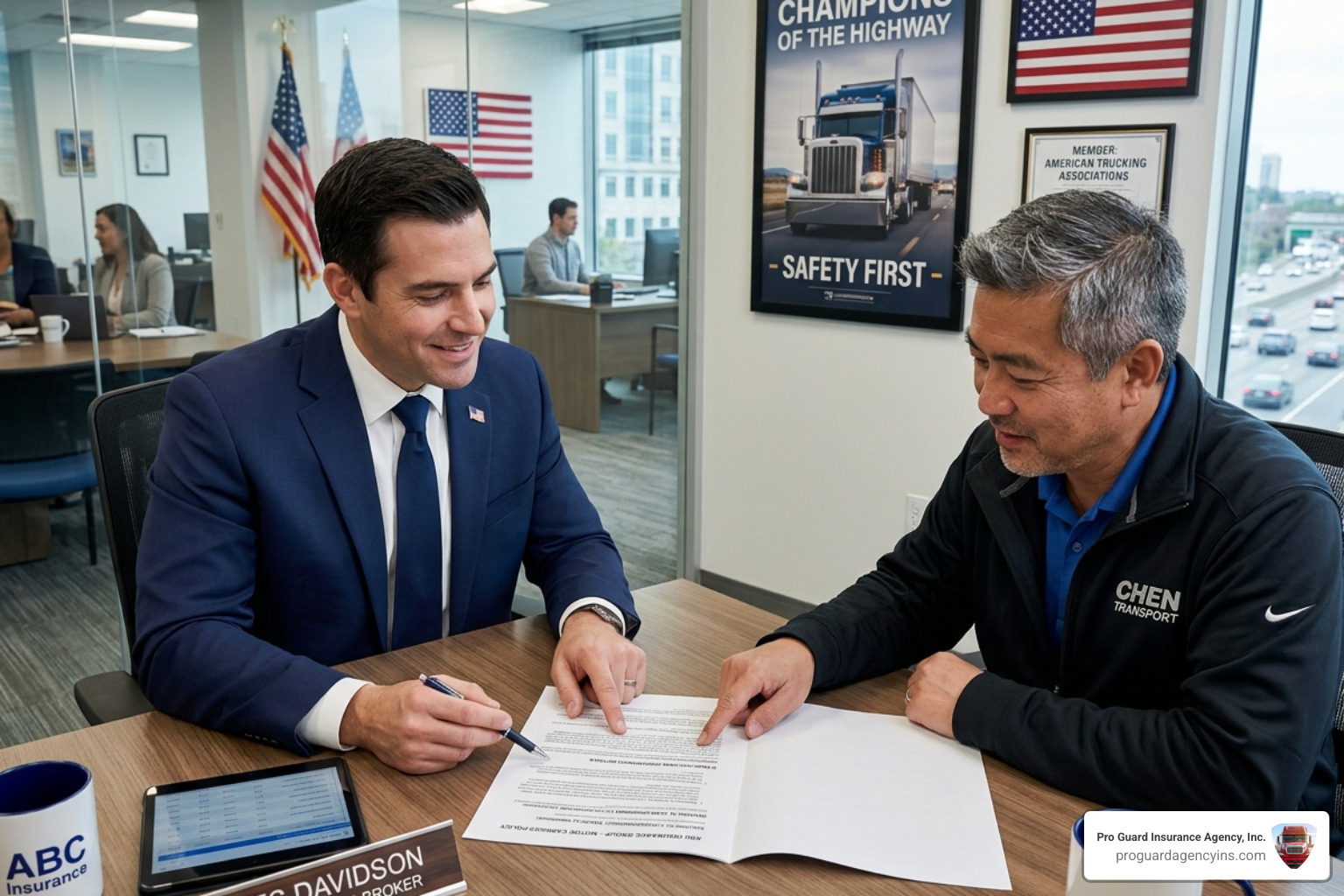
At Pro Guard Insurance Agency, we focus on several key pillars to ensure your operations are protected:
- Motor Truck Cargo Legal Liability: This is the heart of your protection. It covers your liability for cargo that is lost or damaged due to causes like fire, collision, or even equipment failure. However, as we will discuss later, “improper securement” is a common exclusion that requires careful management.
- Commercial Auto Liability: If a load falls off your trailer and causes a multi-car pileup, your cargo policy won’t cover the smashed cars or medical bills—that falls under your auto liability. Given that a single fatal trucking accident can reach $7 million or more in damages, this is non-negotiable.
- Transportation Pollution Liability: What happens if your load includes barrels of chemicals that rupture because they weren’t braced correctly? The cleanup costs can be astronomical. This specialized coverage handles the remediation and legal fees associated with spills.
- General Liability: This protects your business from “slip and fall” type incidents or damage caused at a loading dock that doesn’t involve the truck itself.
Understanding these nuances is vital. For a deeper dive into how to structure these protections, check out A Broker’s Guide to Not Losing Sleep Over Cargo Insurance.
Technical Requirements for a Valid Load Securement Insurance Policy Claim
To have a successful claim under a load securement insurance policy, you must prove that you followed industry “best practices” and regulatory standards. Adjusters look for specific technical markers:
- Working Load Limit (WLL): Every tie-down (chain, strap, or wire rope) has a WLL. The aggregate WLL of all your securement devices must be at least 50% of the weight of the cargo. If you are hauling a 40,000 lb steel coil, your combined tie-down strength must be at least 20,000 lbs.
- Manufacturer Markings: This is a “gotcha” for many drivers. If a strap is missing its tag or the grade is worn off a chain link, regulators (and insurance adjusters) deem its WLL to be zero.
- Performance Criteria: Your securement system must be robust enough to withstand specific g-forces. If a load shifts during a normal turn or a standard braking event, the insurer may argue the load was not “secure” to begin with, leading to a denial.
The Difference Between Cargo Insurance and Legal Liability
It is a common misconception that “cargo insurance” covers everything. In reality, there is a massive difference between Shipper’s Interest Insurance and Motor Truck Cargo Legal Liability.
- Legal Liability: This only pays out if you, the carrier, are found legally responsible for the damage. Under the Carmack Amendment, carriers are generally liable for cargo damage, but there are exceptions (like Acts of God or inherent vice of the goods).
- Shipper’s Interest (All-Risk): This covers the goods regardless of fault. Many shippers prefer this because it pays out faster without needing to prove the driver was negligent.
As a broker, we often recommend The Contingent Cargo Insurance Safety Blanket Every Broker Needs for those who sub-haul or broker loads, ensuring there is a secondary layer of protection if the primary carrier’s policy fails due to a securement violation.
Regulatory Standards: FMCSA and National Safety Code Requirements
Whether you are hauling across state lines in the US or crossing into Canada, the rules for how you tie things down are remarkably harmonized, but the weight thresholds vary.
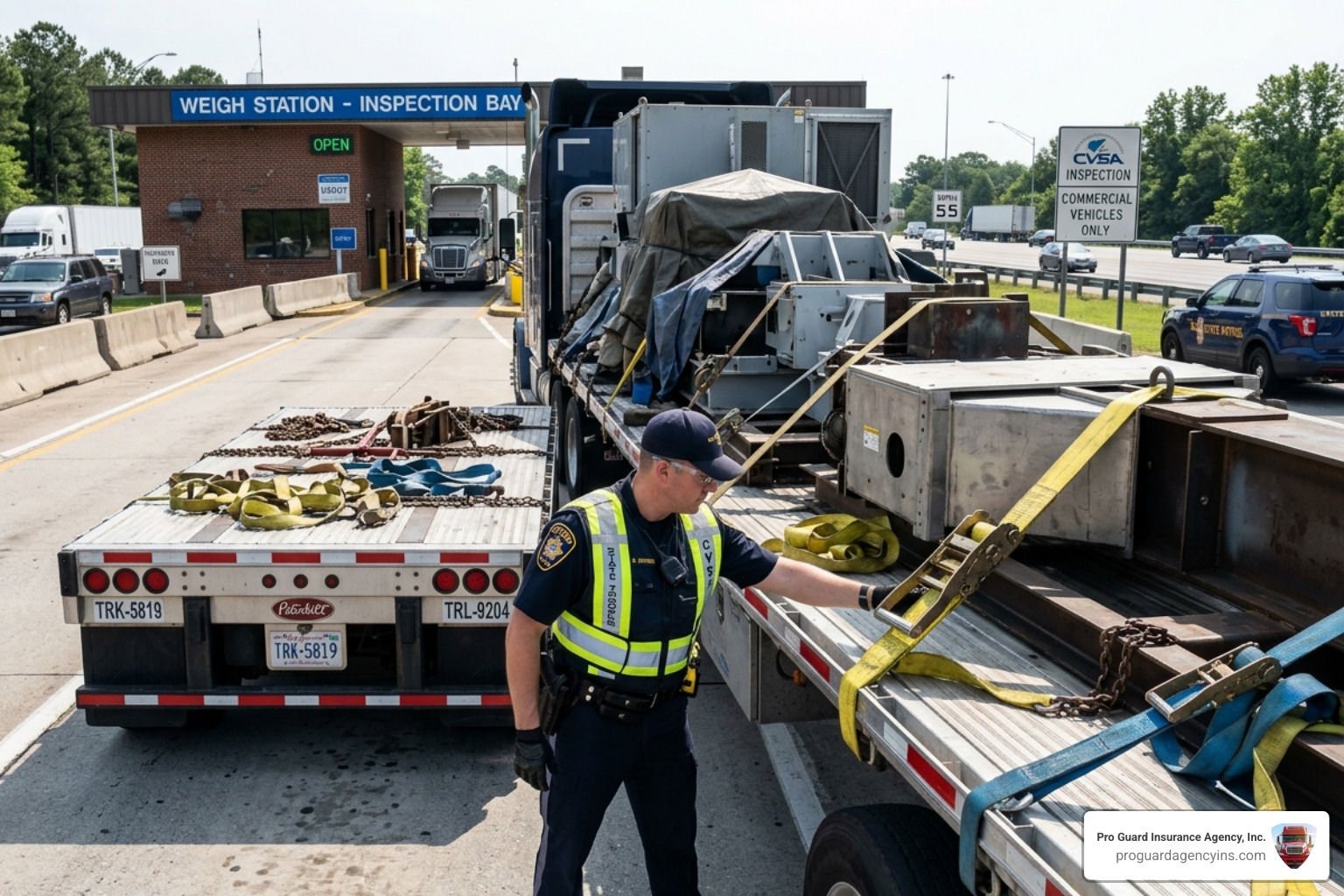
In the United States, the FMCSA (Federal Motor Carrier Safety Administration) governs these rules under 49 CFR 393.100. These regulations apply to all commercial motor vehicles (CMVs) over 10,000 lbs GVWR engaged in interstate commerce.
In Canada, specifically Ontario, O. Reg. 363/04 ties directly into the National Safety Code (NSC) Standard 10. While the physics are the same, Canada uses a 4,500 kg (approx. 9,920 lbs) threshold to determine which vehicles must comply with the more stringent heavy-vehicle rules.
Compliance for Heavy vs. Light Commercial Vehicles
The rules get stricter as the weight goes up. For vehicles under the 10,000 lb / 4,500 kg threshold, the requirements are more general: the load just can’t leak, spill, or blow off.
However, for heavy CMVs, you must follow the 3.04 linear metre (10 feet) rule. Generally, you need:
- One tie-down for articles 5 feet or less in length and 1,100 lbs or less in weight.
- Two tie-downs if the article is 5 feet or less but weighs more than 1,100 lbs.
- Two tie-downs if the article is longer than 5 feet but less than 10 feet.
- For articles longer than 10 feet, you need two tie-downs for the first 10 feet and one additional tie-down for every 10 feet (or fraction thereof) beyond that.
Performance Criteria for Cargo Systems
Your load securement insurance policy assumes you are operating a vehicle that meets these specific force-resistance standards. Every securement system must withstand:
- Forward Force (0.8g): 80% of the cargo weight must be restrained against forward movement (simulating a hard braking event).
- Rearward Force (0.5g): 50% of the cargo weight must be restrained against moving backward (simulating acceleration).
- Lateral Force (0.5g): 50% of the weight must be restrained against sideways movement (simulating a turn).
- Upward Force (0.2g): 20% of the weight must be restrained against lifting (simulating bumps or vibration).
Using tools like friction mats can be a lifesaver—they can actually reduce the number of tie-downs required by increasing the resistance between the load and the trailer floor.
Risk Management: Inspections, Documentation, and Telematics
Safety isn’t just about the straps; it’s about the schedule. The FMCSA and NSC are very specific about when a driver must check their load.
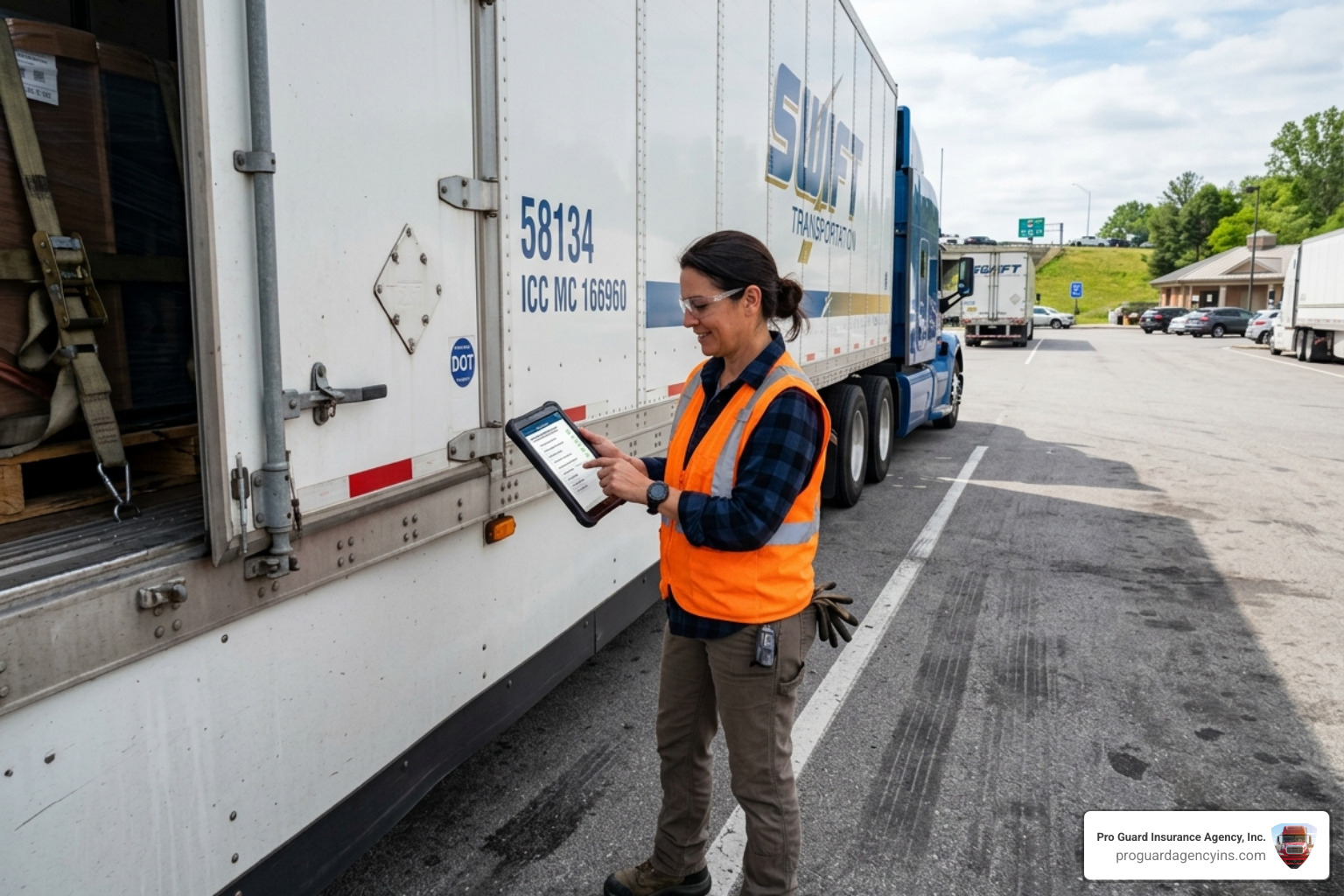
We recommend our clients follow the “Rule of Three” for inspections:
- Pre-Trip: Inspect the load and securement devices before turning the key.
- The First 50: Stop and re-examine the load within the first 50 miles. Cargo often “settles,” causing straps to loosen.
- En-Route: Re-check every 150 miles or every 3 hours—whichever comes first.
How Telematics and Training Lower Your Load Securement Insurance Policy Premiums
In 2026, insurance is no longer a “black box.” Carriers are increasingly using data to reward safe fleets. By implementing telematics and dashcams, you provide proof of “defensive driving.”
- GPS Tracking: Helps recover stolen cargo and verifies routes.
- Dashcams: Can prove that a load shift was caused by an unavoidable “emergency maneuver” (like swerving to avoid a car) rather than negligence.
- Driver Training: Regular workshops on Working Load Limits (WLL) and edge protection show insurers you are a “preferred risk,” which can lead to significant fleet discounts.
Essential Documentation for Claims Approval
If an accident happens, the paperwork is your best friend. To ensure your load securement insurance policy pays out, you should maintain:
- Photos: Take pictures of the load after it’s secured but before you leave the yard.
- Inspection Logs: Digital or paper logs showing you checked the load at the 50-mile mark.
- Bill of Lading (BOL): Ensure the declared value is accurate. In many parts of North America, if no value is declared, the carrier’s liability may be limited to a standard $2 per pound. If you’re hauling high-value electronics, that $2/lb limit could leave your client with a massive financial hole.
Common Exclusions and Financial Consequences of Failure
Most people find out what’s not covered by their policy only after the claim is denied. Here are the big ones:
- Improper Securing: If an adjuster sees a knot in a strap or a chain hooked to a non-rated rub rail, they may deny the claim for negligence.
- Inherent Vice: This refers to damage caused by the nature of the cargo itself (e.g., fruit rotting or metal rusting due to moisture).
- Acts of God: While a tornado is an Act of God, a gust of wind blowing a tarp off is usually considered a failure of securement.
Why Claims are Denied: Improper Handling vs. Negligence
The line between an “accident” and “negligence” is often drawn by the quality of your equipment.
| Factor | Approved Claim (Accident) | Denied Claim (Negligence) |
|---|---|---|
| Tie-down Condition | Rated, tagged, and in good repair | Unrated, frayed, or contains knots |
| Edge Protection | Used on all sharp corners | Missing; strap cut by cargo edge |
| Inspection | Logged at 50-mile mark | No record of en-route inspection |
| Anchor Points | Rated D-rings or winches | Hooked to a non-structural thin rail |
Failure to secure a load doesn’t just result in a denied claim; it can lead to Out-of-Service (OOS) orders during roadside inspections, which ruins your CSA score and drives up your premiums for years.
Frequently Asked Questions about Load Securement
What is the minimum number of tiedowns required for a load?
As a rule of thumb, you need one tie-down for every 10 feet of cargo, but you must always have at least two tie-downs regardless of how short the item is (unless it is blocked/cradled). Always ensure the aggregate WLL equals 50% of the cargo weight.
How does the $2 per pound limit affect my insurance payout?
In many jurisdictions, unless a higher value is declared on the Bill of Lading, the carrier’s maximum liability is $2 per pound. If you destroy 5,000 lbs of cargo worth $100,000, you might only be liable for $10,000. While this protects the carrier, it often leads to lawsuits from angry shippers. We recommend matching your cargo limit to the actual replacement value of your typical loads.
Are drivers responsible for securement if the shipper loaded the trailer?
Yes. Under FMCSA and NSC rules, the driver is ultimately responsible for the safety of the vehicle. “The shipper loaded it” is rarely a valid legal defense if the load falls off. If the trailer is sealed and the driver is forbidden from opening it, different rules apply, but for flatbed work, the buck stops with the driver.
Conclusion
Securing your load is about physics; securing your business is about the right load securement insurance policy. At Pro Guard Insurance Agency, Inc., we don’t just sell policies—we partner with you to manage risk. With our personalized service and access to over 100 carriers, we are licensed in 31 states to provide the specialized trucking insurance you need to keep your fleet moving safely.
Whether you are an owner-operator or managing a growing fleet, don’t leave your livelihood to chance. More info about our trucking insurance services is just a click away. Let’s make sure your next load is as secure as your future.